

Contractor Business Insurance In Texas: What You Need
Texas law doesn’t require contractor business insurance for most trades. Your license, your contracts and the jobs you bid usually do. Electrical contractors, air conditioning contractors and Responsible Master Plumbers must keep general liability on file with the state to keep their licenses. General contractors, remodelers, painters and sheetrock or insulation crews have no state minimum, but the general contractors and property managers who hire them usually ask for proof of insurance before work starts.
This guide covers the Texas rules by trade, the 4 policies most contractors carry, the extra rules on government jobs, what to check in a subcontract and what coverage costs in 2026. If you run a cleaning company, food truck or other business outside construction, start with our small business insurance buying guide.
What Texas requires, trade by trade
Texas doesn’t license general contractors. Remodelers, painters, drywall and roofing contractors don’t need a state license either, so the state sets no insurance minimum for them. Cities can add their own permit and registration rules, so check with the city where you pull permits.
Licensed trades are different: they must keep general liability in force for as long as the license is active. The table shows each state minimum next to what contractors in that trade paid for general liability through Insureon, a national insurance marketplace, in 2026.
| Trade | State insurance minimum | Typical general liability premium (Insureon, 2026) |
|---|---|---|
| General contractor | None | $162 a month nationally, $152 a month in Texas |
| Electrical contractor | TDLR: $300,000 per occurrence, $600,000 aggregate, $300,000 products and completed operations | $61 a month |
| Air conditioning and refrigeration contractor | TDLR: Class A $300,000 / $600,000 / $300,000; Class B $100,000 / $200,000 / $100,000 | $101 a month (HVAC installers) |
| Plumbing (Responsible Master Plumber) | TSBPE: at least $300,000 of commercial liability coverage | $147 a month |
| Drywall and sheetrock | None | $62 a month |
| Painting | None | $72 a month |
| Roofing | None | $317 a month |
Mold remediation and elevator contractors have their own TDLR minimums. A license minimum is rarely what a job asks for: 91% of the contractors who buy general liability through Insureon choose $1 million per occurrence and $2 million aggregate, the limits general contractors most often write into a subcontract.

The 4 policies most contractors carry
1. General liability
General liability pays when your work hurts someone who doesn’t work for you or damages their property: a client trips over your cords, a ladder goes through a window, a nail gun punctures a water line. Ask for products and completed operations coverage, which answers claims that show up after the job is done, such as a leak months after you finish a bathroom. The electrical and air conditioning license minimums include a completed operations limit. General liability doesn’t pay for injuries to your own workers or for your own tools.
2. Workers’ compensation
Texas is the only state that lets private employers choose whether to carry workers’ compensation, and it has worked that way since 1913. Choosing not to carry it has a cost. Employers without coverage lose the limits the workers’ comp law places on their liability, so an injured employee can sue them for negligence, and they still have to file a notice with the state every year and tell their employees in writing. Our small business guide lists those filings step by step.
In 2024, 130 of the 557 people who died from work injuries in Texas worked in construction and extraction jobs, according to the Bureau of Labor Statistics. Workers’ comp pays medical bills and part of the lost wages for employees hurt on the job, whoever was at fault.

3. Commercial auto
Every vehicle on a Texas road needs at least 30/60/25 liability: $30,000 per injured person, $60,000 per accident and $25,000 for property damage. The Texas Department of Insurance lists driving for business among the things most personal auto policies don’t cover, so a pickup or van that carries tools, materials or crew belongs on a commercial auto policy. List every driver and how each vehicle is used.
One of the questions our clients ask most is whether they can insure a vehicle without a U.S. driver’s license. In Texas, you can. We don’t write trucking insurance.
4. Tools and equipment
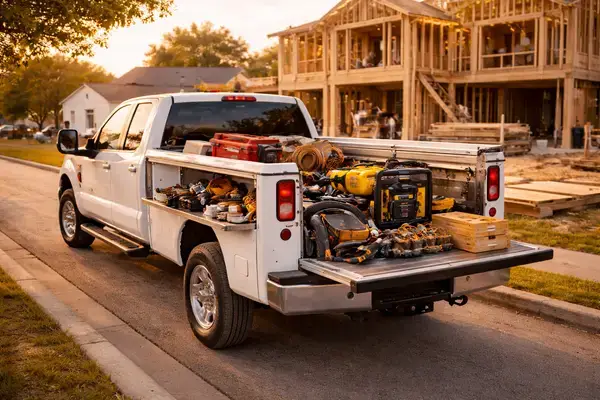
A property policy covers things at a fixed location, like your shop. Tools and equipment coverage, a type of inland marine insurance, follows your gear to the job site, the trailer and storage, so a stolen generator or a dropped laser level can be repaired or replaced. No Texas law or license requires it. Price it if replacing your tools would stop work for a week.
Government jobs: workers’ comp and bonds are required
On a building or construction contract with a Texas governmental entity, workers’ comp stops being optional. The contractor must certify in writing that it covers each employee on the project, and each subcontractor gives the same certificate to the general contractor, who passes it to the entity (Texas Labor Code 406.096). The state rule for these projects, 28 TAC 110.110, adds duties for the contractor:
- Give the entity a certificate of coverage before the contract is awarded.
- Collect a certificate from every person providing services on the project before that person starts work.
- File a new certificate if your coverage period ends before the project does.
- Keep every certificate for the length of the project and 1 year after.
- Post the state’s notice of required coverage at each project site, in English, Spanish and any other language your crew uses.
Public work contracts also carry bond rules. Under Texas Government Code 2253.021, the prime contractor must provide a performance bond on contracts over $100,000 and a payment bond on contracts over $25,000, or over $50,000 when the entity is a city. A performance bond protects the project owner if you don’t finish the work, and a payment bond protects your subcontractors and suppliers if you don’t pay them. Insurance protects you and third parties when something goes wrong. See our surety bonds page or types of construction bonds.
Before you sign a subcontract
The insurance section of a subcontract decides what you buy. Look for these 3 terms. Each one has to be in your policy, usually as an endorsement, before your certificate can show it, because a Texas certificate of insurance can’t say anything your policy doesn’t (TDI certificate rules).
- Additional insured, ongoing and completed operations: the general contractor or owner is covered under your policy for claims tied to your work, during the job and after it.
- Waiver of subrogation: your insurer gives up the right to recover what it pays from the party named in the contract.
- Primary and noncontributory: your policy pays first and doesn’t ask the other party’s insurer to share the loss.
Texas limits how far these clauses can go. The Texas Anti-Indemnity Act, Insurance Code Chapter 151, has applied since January 1, 2012. It voids construction contract terms that make you buy additional insured coverage protecting the general contractor or owner from claims caused by their own negligence. The law has exceptions, including claims for injuries to your own employees and contracts for single-family homes, and it can’t be waived by contract. Ask an attorney about any indemnity clause you don’t understand before you sign.
If a general contractor charges you to work under its insurance, price your own policy. One of our construction clients was paying the company he works for large amounts of money for insurance. He assumed he couldn’t buy his own because he doesn’t speak fluent English. He now has his own policy. When a new contract asks for a certificate, we can issue it the same day for most business policies.
What contractor business insurance costs in 2026
Your price depends on your trade, payroll, crew size, vehicles, limits and claims history. National figures give you a range to plan around:
| Coverage | Insureon (August 2026) | NEXT (November 2026) | MoneyGeek (October 2026) |
|---|---|---|---|
| General liability | $83 a month | $77 a month on average for general contractors; range $56 to $227 | $337 a month on average |
| Workers’ compensation | $160 a month; 48% of buyers pay under $150 | Not published | $211 a month in Texas |
| Tools and equipment | $42 a month | $32 a month on average; range $32 to $64 | Not published |
| Commercial auto | $270 a month | Not published | $193 a month on average |
For general contractors in Texas, Insureon reports $152 a month for general liability, $306 for workers’ comp and $254 for commercial auto.
The 3 sources measure different things. Insureon’s figures come from more than 25,000 contractor customers, most with fewer than 5 employees, and NEXT reports what its own customers pay. MoneyGeek models a business with 1 to 4 employees and $1 million / $2 million limits, which is why its numbers run higher. A painter working alone will price near the low end, and a roofing company with a crew and trucks near the top. Tell us your trade and your contract requirements, and we’ll look for the lowest price that still meets them.

Contractor insurance in English or Spanish
Janeth López owns Paga-Menos Insurance and has 15 years of experience as a personal and commercial lines agent. She graduated from the University of Houston-Downtown in 2014 and built the agency around explaining coverage, especially in Spanish, after meeting Latino business owners who wanted to start a company and didn’t know where to begin.
“I wanted them to know that having the right coverage can lead to many opportunities in business, and being insured correctly means less liability for them.” – Janeth López
We insure construction, painting, sheetrock and insulation contractors across Texas.
- Quote: call (832) 804-9286, message us on WhatsApp or visit 5901 Bellaire Blvd, Suite C, Houston, TX 77081. Monday to Friday, 9:00 am to 6:00 pm; Saturday, 10:00 am to 4:00 pm.
- Certificates: same day for most business policies.
- Payments: monthly installments, autopay or ACH bank transfer.
Paga-Menos Insurance, Texas license #1902026. Request a contractor business insurance quote.
FAQs
Do I need my own insurance if I work as a subcontractor?
Texas doesn’t require it unless you hold an electrical, air conditioning or plumbing license, or work on a government project. General contractors usually ask for your own general liability certificate before you start, and your own policy is the only one you control.
Does general liability cover my work after I finish the job?
It does when your policy includes products and completed operations coverage, which pays for claims that come up after the work is done, such as water damage from a fitting you installed. Check that your policy has it, and what the limit is, before you sign a contract that asks for it.
Do I need workers’ comp if I work alone?
Texas doesn’t require it, and the state’s non-subscriber filings start when you hire your first employee. A general contractor can still require it in your subcontract, and government building or construction projects require coverage for every person providing services on the project.
Can a general contractor make me insure its own negligence?
Not under most Texas construction contracts. The Texas Anti-Indemnity Act voids terms that require additional insured coverage for the general contractor’s own negligence, with exceptions such as claims for injuries to your employees and single-family home projects.
Can I insure my work truck without a U.S. driver’s license?
Yes. In Texas, not having a U.S. driver’s license doesn’t stop you from insuring a work vehicle. List every driver and how the truck is used, and we’ll quote the right policy.
Related articles
- Protecting Your Construction Business in Texas: Essential Insurance Coverage
- Everything You Need to Know About Business Insurance
- What Are Business Insurance Services?
- How to Find Plumber Insurance?
Sources: TDLR electrical contractor license, TDLR air conditioning and refrigeration contractor license, Texas State Board of Plumbing Examiners, Texas Labor Code Chapter 406, 28 TAC 110.110, Texas Government Code Chapter 2253, Texas Insurance Code Chapter 151, TDI Division of Workers’ Compensation biennial report, TDI nonsubscriber reporting, TDI certificates of insurance FAQ, TDI auto insurance guide, Bureau of Labor Statistics, fatal occupational injuries in Texas, 2024, TDI 2024 Texas fatal occupational injuries report, Insureon contractor insurance costs, Insureon general contractor insurance costs, NEXT general contractor insurance cost and MoneyGeek contractor insurance cost.

Janeth López can insure a Texas driver even without a U.S. driver’s license, the kind of policy many families assume isn’t available to them. As an agent at Houston-based Paga Menos Insurance, she covers the whole state across personal and commercial lines, from home, auto, and life coverage to business policies for taquerías, drywall crews, and truckers. She handles all of it in Spanish and builds payment plans around what a client can actually afford.